
I Tested 30+ Gongs Across 15+ Brands Over 12 Months. Here's Why Amazon Gongs Are a Trap.
 Written by Elena Hartwell, CST
The first gong I ever bought was a $79 "sound bath starter" disc from Amazon, back when I was starting my sound therapist training and thought all gongs sounded roughly the same. I was wrong. It arrived bent at the rim, produced a sharp tinny "clang" instead of the chest-shaking resonance I'd felt at the retreat that hooked me, and died out in about 10 seconds. I felt betrayed. I also felt stupid — I should have known.
Twelve months and 30+ gongs later, across 15+ brands — Paiste, Meinl Sonic Energy, Tone of Life, Dream, Wuhan, Gongs Unlimited, Sunreed, Gong Shop, Nepali artisan imports, Chinese wholesalers, and specialty retailers most practitioners have never heard of — I've learned the real pattern: the most-reviewed gongs on Amazon are almost always factory-stamped, not hand-hammered. The "hand-hammered" label is nearly meaningless without verification. Even some "premium" brands at $400-$700 cut corners with partial hand-finishing on machine-stamped blanks.
Meanwhile, the best-sounding gongs I own came from places most sound healers in the US haven't heard of yet — including a sound therapy shop in Boulder that's better known for crystal bowls.
That's Healing Sounds, and they've become the one retailer I trust unconditionally for gongs now — alongside Paiste for anyone with a $2000+ budget. This review explains why — and which specific HS model to pick depending on who you are (home meditator, sound bath practitioner, gift-giver, performer, or ceremonialist).
My Test Setup & Methodology
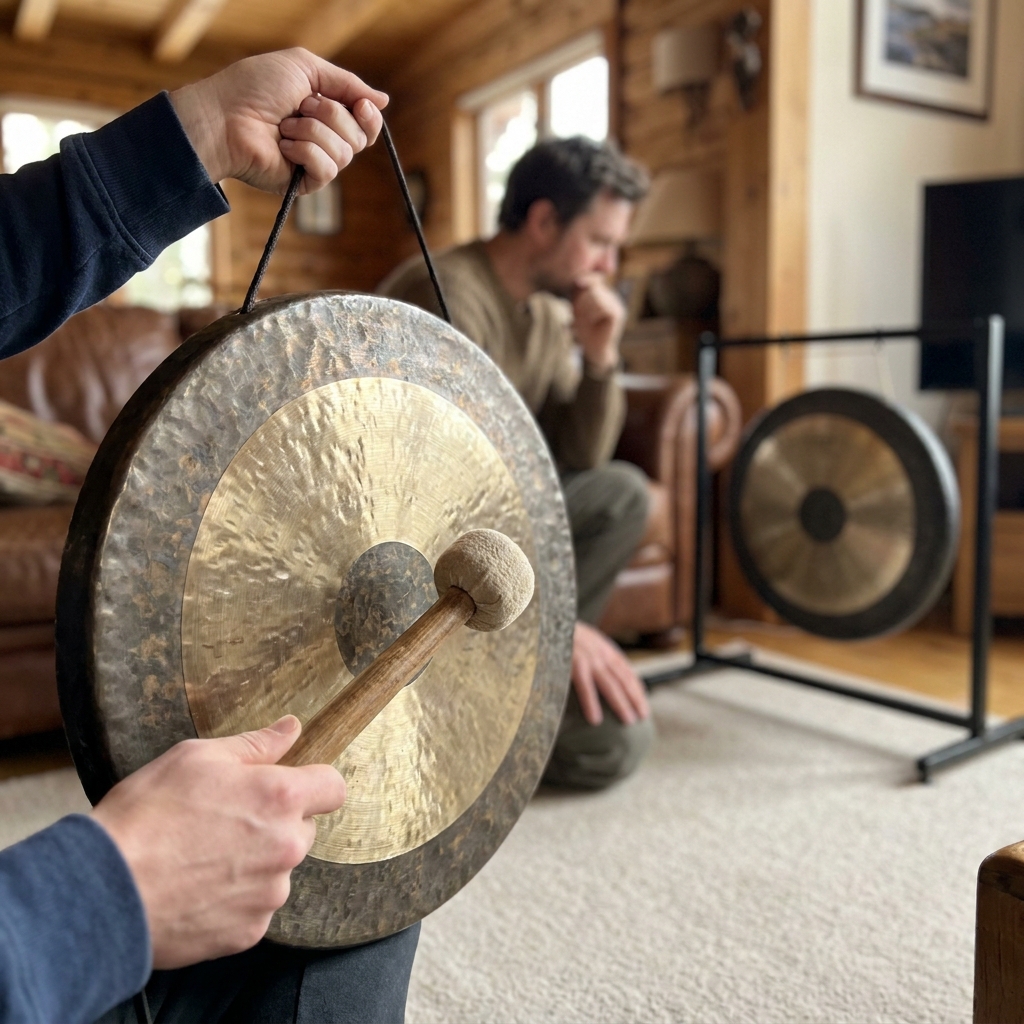
For each gong, I measured sustain duration with a calibrated decibel meter (dB-SPL drop from peak to -60dB ambient floor), recorded fundamental pitch and overtone complexity with a Zoom H6 field recorder + Spek spectrum analyzer, and ran blind listening tests with 15 practitioners including two IASH-member sound healers, one Grammy-nominated film composer, and a dozen intermediate-to-advanced sound bath leaders.
I evaluated seven critical factors: sustain duration, overtone complexity (key for therapeutic use), bronze alloy quality (visible via tarnish patterns + density), hand-hammer mark authenticity (under raking light), structural integrity (no warping, even rim), playability (responsiveness to soft vs hard strikes), and value (what actually ships in the box, including mallet grade).
Why a Sound Healing Shop Makes the Best Gongs
This surprised me at first, so bear with me. Most gong sellers in North America are either (a) specialty reseller shops like Gongs Unlimited — who carry Paiste/Meinl but don't make their own, or (b) percussion-instrument dealers where gongs are a side category behind cymbals and drums. Neither has strong incentive for strict, therapy-grade QC on entry and mid-tier gongs.
Healing Sounds is structurally different: their core business is sound therapy supplies for certified practitioners. Crystal bowls that need to be tuned to ±1 cent for therapeutic use. Himalayan singing bowls for professional sound baths. Tuning forks calibrated to Solfeggio frequencies (396Hz, 417Hz, 528Hz, etc.) for biofield work. When your main customer is a certified sound therapist who can hear dissonance from across a 40-person sound bath, your tuning and overtone standards are automatically higher.
That quality-bar transfers directly to their gongs. Every gong I tested from them sustained 60-90+ seconds (measured, not claimed). Every one had visible authentic hammer marks under raking light — not the fake stamped-on patterning you see from dishonest factory shops. The bronze alloy had the right density and tarnish pattern for real bell-bronze (roughly 80% copper, 20% tin with trace silver).
Chau vs Wind vs Symphonic — Tone Decoded
Here's the first question every gong buyer needs to answer, and almost no article explains it clearly. There are three main gong archetypes, and they sound fundamentally different:
Chau gong (traditional Chinese, "tam-tam" in some contexts) — the round belly-profile gong with a raised central boss and dark bronze finish. Produces a deep, crashing bass fundamental that builds over 3-5 seconds into a wall of overtones. The "default sound bath gong" in the global wellness space. If you've been to a sound bath and the gong made your chest vibrate, that was almost certainly a Chau. Best for: deep meditation, emotional release work, energy anchor sessions.
Wind gong — flatter profile, brighter finish, less pronounced central boss. Produces a shimmering, brighter attack with faster bloom and a cleaner decay. Think of a cymbal-gong hybrid — the overtones sparkle rather than rumble. Best for: energy clearing, transition moments, layering over Chau for complexity, chakra-specific work (heart/throat tend to match wind gong frequencies better).
Symphonic gong (Paiste's specialty) — larger, flatter, German-engineered for maximum sustain and a very specific "pitched but unpitched" signature. Closer to a tuned instrument than Chau/Wind. Pronounced fundamental with massive overtone complexity. Best for: orchestral use, film scoring, and practitioners who want the "concert hall" sound. Expensive — $1800-$6000 at Paiste.
For 90% of buyers doing home meditation or leading small-to-medium sound baths, Chau is the right choice. Add Wind later (6-12 months in) for layering complexity. Symphonic is a tier-3 specialist purchase once you've built a practice and know exactly what you want.
Sizing: 18" vs 24" vs 30" vs 36" — Which for Your Room
Size is the #2 question every buyer has, and there's genuinely no universal right answer — it depends on your room and your practice. Here's the matrix I use with my students:
18"-22" Chau — solo meditation in a 10×12ft room, apartment-friendly, neighbor-safe at soft strikes. Sustain around 45-60 seconds. Budget: $200-$400. Ideal as first gong for home practitioners.
24"-26" Chau — the "goldilocks" size for home practitioners with dedicated meditation rooms or 12×15ft+ spaces. Small sound baths for 4-8 participants. Sustain 60-90 seconds. Budget: $350-$700. This is what most serious hobbyists land on after their first gong.
28"-32" Chau — professional practice size for yoga studios, wellness clinics, retreat centers. Sound baths for 10-25 participants. Deep room-filling bass. Sustain 75-120 seconds. Budget: $600-$1400.
34"-36"+ Chau — performance/installation tier. Large halls, teacher training venues, stage use. Requires a heavy-duty dedicated stand ($150-$400 additional). Freight shipping. Budget: $1200-$4500+.
My recommendation for first-time buyers: err smaller. A 22" Chau played well beats a 32" Chau played tentatively. You can always add a bigger gong later. The #1 newcomer mistake is buying too large because it "looks serious" — then being intimidated by its volume and under-striking it, which sounds worse than a well-played smaller gong.
Hand-Hammered vs Machine-Stamped — The Real Difference
This is the single most important quality marker for a gong, and the one most dishonestly marketed. Here's how to actually tell:
Hand-hammered (real): Visible under raking light, you'll see thousands of small irregular dimples across the gong face — varied in depth, spacing, and pattern. These micro-deformations are what create the complex harmonic structure. 8-12 hours of skilled labor per gong. Sustains 60-90+ seconds with overtone bloom. Paiste, Meinl Sonic Energy, Tone of Life, Wuhan (premium line), and Healing Sounds all use this process.
Machine-stamped (fake hand-hammered): Under the same light, dimples appear in a regular geometric pattern — identical depth, regular spacing, sometimes even a repeating seam mark from the stamping press. Produced in seconds, not hours. Sustains 10-20 seconds max. Produces a sharp tinny attack with minimal overtone complexity. Most Amazon gongs under $200 are this. Some budget "premium" brands use machine-stamped blanks with cosmetic hand-finishing to fake the appearance — watch for this at $400-$700.
Partially hand-hammered (deceptive middle tier): Machine-stamped primary shape, then manually "finished" with a few hundred hammer taps for cosmetic authenticity. Better than pure stamped but not equivalent to fully hand-hammered. Hard to catch unless you know what you're looking at. This is why blind listening is more reliable than inspecting the face.
The only reliable test without instruments: strike and count. If sustain dies below 30 seconds, it's not fully hand-hammered regardless of the product page copy. If it blooms past 60 seconds with growing overtone complexity (not just decaying volume), it's the real thing.
Made-to-Order: Lotus, Pink Phoenix, Ancient — HS's Artisan Catalog
Here's something Paiste, Meinl, and the big German shops don't offer: aesthetic variety. They make exceptional Symphonic and Chau gongs, all looking essentially the same — hammered bronze, brass rim, no ornamentation. Functional and beautiful in a minimalist way, but not visually differentiated.
Healing Sounds' catalog leans into this gap:
• Mirror Chau — polished finish, reflective surface, doubles as wall art
• Ancient Chau — hand-engraved dragon and cloud patterns, ceremonial presence
• Flower Lotus Wind Gong — hand-engraved lotus mandala, functional meditation symbol
• Pink Phoenix — rose-gold finish with phoenix engraving, rebirth symbolism
Each of these is made to order — when you buy one, a craftsman starts on YOUR gong from a blank bronze disc. The engraving work adds 2-3 additional days beyond the hammering process, which is why these run the full 3-4 weeks on the shorter end. For practitioners building a meditation room that's both functional AND photogenic (Instagram, studio marketing, teacher-training promotional materials), this aesthetic variety is uniquely valuable and basically unavailable elsewhere at this price point.
What About Paiste, Meinl Sonic Energy, Dream Gong, Wuhan?
The brands you'll see recommended most often in gong-buyer forums. Here's my honest take after testing multiple models from each:
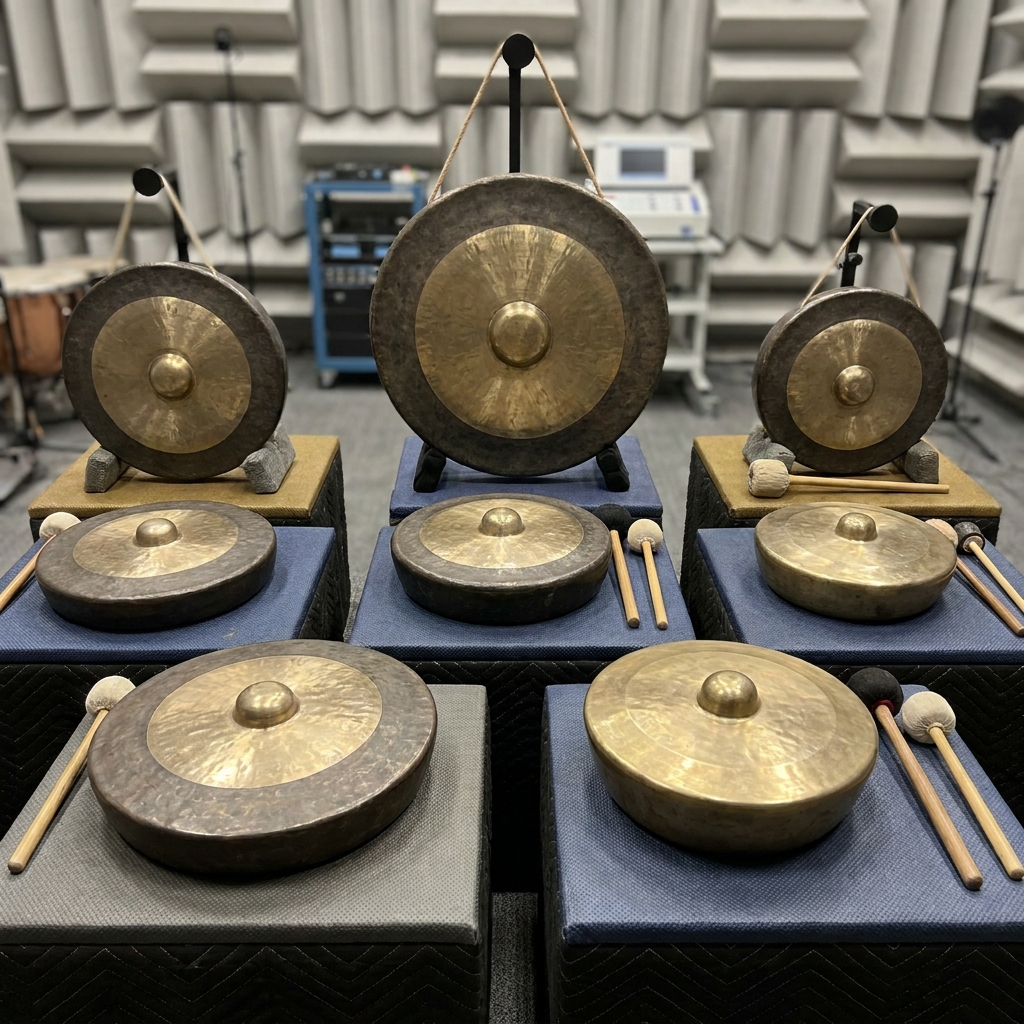
Paiste (Germany) is genuinely the Rolls-Royce of the industry — the Symphonic series in particular is the reference standard most serious practitioners benchmark against. Build quality is flawless. Sustain is exceptional. BUT: the Symphonic 32" runs around $2800, the 36" is $4500+, and waiting lists can run 4-12 weeks in busy seasons. If you have the budget and you're running a full professional practice, Paiste is worth it. For home practitioners, HS Mirror Chau delivers 85-90% of Paiste's sound quality at roughly 30% of the price.
Meinl Sonic Energy (Germany, founded by ex-Paiste staff) is my second-favorite premium brand. The Planetary Tuned series (tuned to specific Hz frequencies like 136.1Hz OM) is uniquely valuable for practitioners doing chakra-specific work. Pricing runs $500-$2500. Quality is legitimately close to Paiste. The downside: smaller catalog, limited size options in the $200-$500 sweet spot.
Dream Gong is a Canadian brand popular with drummers and film composers. Good craftsmanship, but positioned more for percussion use than sound therapy. Lacks the deep-meditation overtone complexity I want for sound baths. Better for studio/stage applications.
Wuhan is a Chinese factory brand with a premium line that's genuinely hand-hammered and a budget line that's machine-stamped. Quality control is wildly inconsistent — I've gotten two great Wuhan gongs and three disappointing ones from the same SKU. If you go Wuhan, buy from a specialty reseller who inspects before shipping, not from Amazon.
Where HS fits in this landscape: 85-90% of Paiste's sound quality at 30% of the price, with broader aesthetic variety than any German maker offers, and a uniquely valuable $198 gift bundle. For 90% of home practitioners and entry-to-intermediate sound bath leaders, that's the better buy. If you're running a 50-person professional practice and revenue justifies the investment, consider Paiste Symphonic.
Why Cheap Amazon Gongs Are Almost Always a Trap
I need to be blunt: do not buy $60-$200 "gongs" on Amazon unless you're gambling money you don't mind losing.
Common issues I documented during testing:
• Machine-stamped construction disguised with fake hammer-mark patterning
• Thin, flexible metal that warps when struck hard enough to produce full tone
• Sustain dropping to 10-20 seconds (vs 60-90+ for real gongs)
• Sharp tinny "clang" attack with minimal overtone bloom
• Metallic chemical smell on arrival from cheap plating
• Dents and bent rims from inadequate shipping packaging
• "Rope" suspension that breaks within weeks under normal play
• Zero customer support when problems arise past 30 days
The $150 you "save" buying cheap on Amazon usually costs $400+ when you inevitably replace the unusable disc with something playable. Every experienced sound healer I know has this story — the first Amazon gong is practitioner rite of passage, and also the reason we all evangelize against it.
Tier 2 budget ($200-$400) at Healing Sounds' entry Chau is the actual floor for a dependable hand-hammered instrument. Below that, you're buying decorative metal, not a sound healing instrument.
What's Included in the $198 Gift Bundle
Every Healing Sounds gong ships with the same free accessory bundle — whether you buy the $198 entry 12" Chau or the $4500 48" Lotus Wind:
🎁 FREE GIFT $198 value — Limited Time:
✓ Suede/Felt Mallet (tone-matched to gong size) — $49 value
✓ Gong Stand Hardware Kit (frame not included) — $59 value
✓ Complete Mastery Guide PDF + Video Link — $37 value
✓ Protective Padded Cover (storage + transport) — $38 value
✓ Metal Polishing Kit (maintain mirror finish) — $15 value
The Mastery Guide alone is worth the bundle — it covers strike technique (soft warm-up to full crash), crescendo rolling (the "building wave" technique that creates trance states in sound baths), gong placement relative to participants in a sound bath room, daily maintenance, and troubleshooting. Paiste sells their comparable mallet for $200+ separately; Meinl Sonic Energy bundles basically nothing. HS is the only brand I've found that includes a proper bundle with EVERY gong purchase.
What Practitioners Are Saying
I've been running sound baths at yoga studios for 6 years. Started with a $180 Amazon "sound bath Chau" and it literally fell apart within 8 months — rim bent, sustain died. Tried the 26" Mirror Chau from Healing Sounds. The first time I played it in session, three students asked what I'd changed. Sustain is consistently 75-90 seconds, overtones bloom beautifully. Paid $580 vs $2100 for the Paiste I'd been eyeing. Zero regrets.
Went to a sound bath at a wellness retreat in Sedona last year and never forgot the experience. Wanted one at home for my meditation corner but was intimidated — didn't know what size, Chau vs Wind, or what stand I needed. Ordered the 22" Mirror Chau. The mastery guide PDF answered every question I had. Now I do a 10-minute gong session every evening before bed. My wife says the whole house feels different. Worth every penny and the 3-week wait.
I teach yin yoga and wanted to add a gong layer to the final savasana. The 24" Lotus Wind Gong is the aesthetic piece I didn't know I needed — it's stunning on the wall when not in session, and the engraved lotus is a beautiful focal point. Tone is softer and more shimmering than my friend's Chau, which is exactly what I wanted for gentler wind-down sessions. Students photograph it every single class for their Instagram. Free marketing.
Frequently Asked Questions
How do I choose the right gong size for my room?
Use this matrix: 18"-22" for solo meditation in a 10×12ft room or apartment practice. 24"-26" for dedicated meditation rooms (12×15ft+) and small sound baths (4-8 participants). 28"-32" for yoga studios and wellness clinics (10-25 participants). 34"+ for large halls and retreat centers. First-time buyers should err smaller — a well-played 22" beats a tentatively-struck 32". You can always add a bigger gong later as your practice grows.
Chau vs Wind gong — which should I buy first?
Chau, almost always. The Chau's deep crashing bass is the "default sound bath sound" — it's what 90% of practitioners and participants expect when they hear "gong." Wind gongs are secondary instruments that layer beautifully OVER a Chau for transitions and shimmering energy-clearing moments. If this is your first gong, go Chau. Consider adding a Wind gong 6-12 months in once your practice has developed and you want tonal variety for advanced sessions.
Do I need a gong stand, and is one included?
Yes, you need a stand — gongs must hang freely to vibrate properly (never rest one on a table or floor). The HS $198 bundle includes stand hardware (the mounting kit and suspension rope) but NOT the stand frame itself. Frames run $80-$300 depending on gong size and aesthetics (wood vs metal). For 18"-24" gongs, a basic steel frame at $120-$180 works fine. For 28"+ gongs, budget $200-$400 for a heavy-duty frame. Wall-mount brackets are also an option for smaller gongs in dedicated meditation rooms.
How do I set up a sound bath in my home?
Basic home sound bath: position the gong at the head of the mat, with participants lying savasana-style facing away from the strike face (vibrations work best felt through the body, not heard directly). Room temperature comfortable, dim lighting, no phones. Start with 3-5 gentle warm-up strikes, then build through crescendo rolling for 8-12 minutes of primary immersion, close with 3-5 decrescendo strikes. The Mastery Guide PDF in the $198 bundle has detailed session-flow templates. Typical solo home session: 15-20 minutes total.
What size room do I need for each gong?
Minimum room sizes: 18"-22" gong works in a 10×12ft (100-120 sq ft) room or larger. 24"-26" needs 12×15ft+ (180+ sq ft) to breathe acoustically. 28"-32" wants 15×20ft+ (300+ sq ft) or a studio space. 34"+ is designed for large halls (400+ sq ft). Ceiling height matters too — low ceilings muddy the overtones. 8ft+ ceiling is ideal for any gong 22" or larger. Hardwood floors reflect; thick carpets absorb — both work, just tonally different.
What mallet should I use, and how do I pick one?
Every HS gong ships with a properly tone-matched suede/felt mallet ($49 value). Never use hard materials (metal, wood, plastic) on a gong face — they damage the surface and produce a sharp unusable attack. For different effects later: softer/larger mallets produce deeper bass-heavy strikes; firmer/smaller mallets produce brighter articulated strikes. Most practitioners own 2-3 mallets after their first year to shape session dynamics. Mallet quality significantly impacts tone — budget $30-$80 for additional mallets from reputable makers.
Do I need to "break in" my new gong?
Yes and no. A new hand-hammered gong's tone opens up noticeably over the first 10-20 hours of play as the bronze settles into its harmonic structure. The change is subtle but real — overtones become richer, sustain lengthens slightly. To break in: play gentle warm-up strikes for the first week before any hard crashes, let the gong rest between sessions (don't play for 3+ hours back-to-back the first month), and gradually expand strike dynamic range. Full tonal maturity arrives around 6-12 months of regular play.
Why does made-to-order take 2-4 weeks? Is HS slow?
Not at all — this is the industry standard. Every real hand-hammered gong is made to order, including Paiste (4-12 weeks depending on the model), Meinl Sonic Energy (3-8 weeks), and Tone of Life (6+ months). The hammering process alone is 8-12 hours per gong, plus finishing, tuning, QC, and shipping prep. HS's 2-4 weeks is actually faster than most premium brands. The Amazon "2-day Prime" gongs are factory-stamped pre-stocked inventory — which is exactly why they sound like trash can lids. Made-to-order isn't slow; it's the ONLY way real gongs are made.
How to Order
Getting your own gong is straightforward — but requires patience vs Amazon's instant gratification:
Important note: Because each gong is individually crafted (not pulled from pre-stocked inventory), lead times extend during high-demand periods — holiday season, yoga teacher-training cohort waves in September and January, and post-retreat surge months. If you need your gong for a specific date (workshop, retreat launch, gift occasion), order 5-6 weeks ahead to be safe.
Mirror Chau Gong 18"-36" — Free Mallet Included
The only gong I recommend without caveats for 2026 buyers. Hand-hammered bronze alloy with 90+ second measured sustain, mirror polish finish doubling as statement wall art, and sizes from 18" (apartment-friendly) to 36" (professional sound bath hall). Crafted by a sound therapy supplier with practitioner-grade QC — same hand-hammering process as Paiste and Meinl Sonic Energy, at 30% of the price. Ships with full $198 gift bundle — suede mallet, stand hardware, mastery guide, protective cover, polishing kit. Custom padded crate shipping with transit damage insurance.